VOTING TIME!!!!!!!!!
Here is a useful election FAQ if you're unsure about how long voting will take, how to vote if you wear a face covering, or what kind of ID you can bring.
Still undecided? Here's one more platform-comparing tool.
And now go vote! And to awesome people like my Awesome Housemate who are working the polls this election: you guys are awesome. You are like millions of hand across the country holding the democracy tent over our heads.
Okay, awkward simile time is over. Time to vote!

Youth Voters in Canada Fighting the Apathy Label
Showing posts with label raise your voice. Show all posts
Showing posts with label raise your voice. Show all posts
Monday, May 2, 2011

Sunday, May 1, 2011
Coast-to-Coast with Editorials
So this is pretty neat. It’s a collection of abridged editorials from across the country. I, of course, cannot refrain from adding my commentary.
From the Vancouver Sun:
False. We are not a republic. Not knowing who the leader of our government will be doesn’t really change much. The prime minister is the leader of the party that forms the government. Let’s not inflate the position with too much importance.
Honestly, majorities are scarier because they’re the closest this country can legally get to a dictatorship. Minorities have to compromise, not be reckless—be predictable. Majority governments have historically been the most unpredictable, and passed the most bills that weren’t in their platforms.
And you know what? No matter what happens in the House of Commons, the core of the civil service remains stable, with just a few changes at the upper bureaucratic levels. Civil servants will be peeved if the upper administration keeps changing on them like that, but the people who actually do the stuff to run our country are going to be here doing the stuff that runs the country regardless of the situation in the House.
From the Winnipeg Free Press:
Oh, please. Our economic recovery is hardly fragile, little thanks to the Conservatives. It was Paul Martin’s banking regulations that left us in such a good place to being with. And as I mentioned earlier, no one ever is “ultimately in charge.” The prime minister’s powers are supposed to be fairly limited, to a leadership role over his own party, and the ability to appoint people and recommend things to the governor general. In fact, the Speaker of the House is far more “ultimately in charge” of the House of Commons.
Of course a “hidden, right-wing agenda” hasn’t emerged over the last five years—that kind of thing is really difficult to have with a minority government. The fact that we haven’t seen a hidden right-wing agenda doesn’t mean there isn’t one (not that I’m saying there is).
From the Halifax Chronicle Herald:
True that. Truuue that.
From the Vancouver Sun:
…the Conservatives should be returned to Parliament with a majority. A minority government will be unstable at a time when we need stability. Without a majority, Canadians will have no idea who their leader will be. The fact is that the opposition could defeat the government on the budget within a matter of weeks of the next sitting of Parliament. Then, either Ignatieff (or possibly his successor, whoever that might be) or Layton could ask the Governor-General to invite one or the other or both of them to form a government.
. . . Canada can't afford an election that delivers a result with so much uncertainty.
. . . Despite the Tories' flaws, however, a Conservative majority is the only path that at this time leads us to a Canada that will remain the prosperous, peaceful and predictable country in which we are fortunate enough to live.
False. We are not a republic. Not knowing who the leader of our government will be doesn’t really change much. The prime minister is the leader of the party that forms the government. Let’s not inflate the position with too much importance.
Honestly, majorities are scarier because they’re the closest this country can legally get to a dictatorship. Minorities have to compromise, not be reckless—be predictable. Majority governments have historically been the most unpredictable, and passed the most bills that weren’t in their platforms.
And you know what? No matter what happens in the House of Commons, the core of the civil service remains stable, with just a few changes at the upper bureaucratic levels. Civil servants will be peeved if the upper administration keeps changing on them like that, but the people who actually do the stuff to run our country are going to be here doing the stuff that runs the country regardless of the situation in the House.
From the Winnipeg Free Press:
That the country even talks about coalitions composed of weak parties focused on buying votes, instead of focusing on the fragile economic recovery, is all the evidence Canadians should need to conclude that seven years of minority government, of the posturing and name-calling and brinksmanship that results when no one ultimately is in charge, must end. Canada must get more serious about its present predicaments and future prosperity. That leaves only the Conservatives.
To be sure, Conservatives over the past five years, and Prime Minister Stephen Harper in particular, have contributed much to the rancour that today sours our polity. But just as surely, over the past five years no political party or leader has shown more disciplined commitment to the engine that makes all else possible — the economy. For all the talk of a hidden, right-wing agenda, none has emerged over five years and there is no evidence it will over the next four.
Oh, please. Our economic recovery is hardly fragile, little thanks to the Conservatives. It was Paul Martin’s banking regulations that left us in such a good place to being with. And as I mentioned earlier, no one ever is “ultimately in charge.” The prime minister’s powers are supposed to be fairly limited, to a leadership role over his own party, and the ability to appoint people and recommend things to the governor general. In fact, the Speaker of the House is far more “ultimately in charge” of the House of Commons.
Of course a “hidden, right-wing agenda” hasn’t emerged over the last five years—that kind of thing is really difficult to have with a minority government. The fact that we haven’t seen a hidden right-wing agenda doesn’t mean there isn’t one (not that I’m saying there is).
From the Halifax Chronicle Herald:
Voting intentions have moved to the poles as we have got closer to the polls, turning this into an effective contest of the NDP left and the Tory right.
You can peg this partly on Prime Minister Stephen Harper being a polarizing leader. And also on his strategy of eking out a majority by winning over targeted demographic groups in a few marginal ridings instead of aiming to make the Tories a bigger-tent party.
That left a lot voters essentially disengaged. But they have decided they want to be heard in this election. And they've been jumping to Jack Layton to do that . . .
It's an astonishing result when most people, at heart, are probably still somewhere in the middle, not looking either for a big expansion of government, or a drastic shrinkage of the social safety net, but simple competence in managing the economy and public finances and in ensuring crucial public services like health care are there when needed.
True that. Truuue that.
Saturday, April 30, 2011
Saturday Morning Catch-Up
Some news stories from the past few days I haven't gotten around to yet.
1) What would a Harper majority look like? To me, scary, but I think that this author is intentionally trying to be terrifying:
*shudder* Also, I just want to say that I don't think you need to make citizenship harder to get when the majority of adults born in Canada already can't pass citizenship tests. I remember my friends memorizing long lists of lieutenant-governors past, and I can't even name any of the current ones.
2) Reality Check on post-election scenarios and the constitution. This lays out potentials for what might/could happen with various election results. With a Conservative minority:
3) There have been some youth debates this week, which are interesting to look at not only because it's young people being completely politically involved, but also because they actually cover youth issues (and articulate what they think youth issues actually are). For example:
4) It's hard to respect our MPs when their behaviour would be getting them a time-out if they were children.
5) If young women voted, things would be different. We already know that the composition of Parliament is more likely to reflect the votes of older men rather than younger women. This survey also points out to some striking differences of opinion between young women and young men.
Here's some stats:
I think the first statistic is possibly the most striking. All the young men surveyed felt Canadian girls receive adequate support to achieve their potential, but less than two thirds of the young women surveyed agreed.
1) What would a Harper majority look like? To me, scary, but I think that this author is intentionally trying to be terrifying:
While parties in modern Canada rarely ask for a majority expressly to do big things, it endows them with unfettered authority. A majority as prime minister allows you to summon and dismiss Parliament, set election dates and name the governor general, senators and judges, among other appointments.
By and large, you are — borrowing a line from Globe and Mail columnist Jeffrey Simpson — a "friendly dictator."
So what would Stephen Harper do? While he may pay lip-service to social conservatives, he is unlikely to reopen the debate on abortion, same-sex marriage and capital punishment. He knows that's playing with fire.
What he is more likely to do, though, is what he is doing already: appoint more conservative judges, deny funding to liberal-minded non-governmental organizations like Planned Parenthood, abolish the gun registry and get tough on crime.
Where he is likely to move aggressively is reshaping the state? Here, expect him to use the deficit as reason to shrink the size of government. That may mean slashing the public service, starving (or selling) the CBC, and privatizing government services.
Expect him to lower taxes and explore ways to empower the individual. Expect him to reform the Senate. Expect him to offer the provinces new authority, including Ottawa's residual powers. While he is unlikely to initiate constitutional reform (he doesn't like convening first ministers), expect the national government to be less national.
At the same time, watch for the Conservatives to give more substance to citizenship, which they think is too easy to acquire. There will be new emphasis on national history and national symbols, particularly the monarchy. The Conservative will continue to trumpet the North, espousing a new kind of nationalism.
Abroad, Canada will continue to regard the United Nations suspiciously. There will be no return to peacekeeping, as the Liberals suggest, or a human-security agenda. Military spending will rise while international assistance is reassessed. A foundering CIDA will be reorganized, even abolished.
The government will pursue a new deal with the United States on border and security issues. It will build on new free trade with Europe. Canada will remain Israel's best friend.
Those who expect the same tone and tenor of the last five years — a centrist stewardship, reflecting a comfortable moderation, veering right only on the margins — should not be surprised to see the empowered Conservatives abandon that kind of caution.
*shudder* Also, I just want to say that I don't think you need to make citizenship harder to get when the majority of adults born in Canada already can't pass citizenship tests. I remember my friends memorizing long lists of lieutenant-governors past, and I can't even name any of the current ones.
2) Reality Check on post-election scenarios and the constitution. This lays out potentials for what might/could happen with various election results. With a Conservative minority:
All we know for certain is that in this third scenario, a minority Conservative government would have to table a throne speech to lay out its priorities and a budget (the one in March was never passed), presumably within the next month or so.
If a minority Conservative government were to lose either of those votes, or any confidence vote within, say, four to six months, Harper would have to resign. But he would have the option of asking Gov. Gen. David Johnston for another election.
Normally, the governor general is supposed to act on the "advice" of the prime minister. But in special circumstances like these, "the reserve powers of the Crown come into play," Franks points out.
"These reserve powers permit the governor general to reject Mr. Harper's advice if he requests a dissolution when he holds a minority of seats in the House of Commons and is defeated early in the session of the new Parliament."
At that point, the governor general would inquire whether another party leader could gain the confidence of the House and govern instead, with the support of one or more other parties.
Franks suggests Johnston might well make the leaders commit to such an arrangement for 18 months to two years; indeed, commit to it in writing and make the agreement public.
Franks is basing these time limits - at least four to six months before Johnston would grant another election, and 18 to 24 months for an alternative government to work - on what Adrienne Clarkson wrote about her preparations in case Paul Martin's minority Liberal government fell back in 2004.
That was the year, incidentally, when Harper, Bloc Leader Gilles Duceppe and NDP Leader Jack Layton prepared a letter to remind Clarkson that she didn't necessarily need to grant an election if Martin lost a confidence vote in the House.
Overall, Franks says, "the governor general's first and most important duty is to ensure that there is a prime minister."
3) There have been some youth debates this week, which are interesting to look at not only because it's young people being completely politically involved, but also because they actually cover youth issues (and articulate what they think youth issues actually are). For example:
Elizabeth Dubois, chair of the campus political action committee for the Young Liberals of Canada, reminded young Canadians of the Liberals' Learning Passport, which would provide $1,000 of financial assistance to post-secondary students each year for up to four years.
She said the platform promise was designed to ensure youth had access to "tools to build our future."
Alykhan Velshi, who is working a second election in the Conservative party war room, insisted that the Liberal plan isn't the best option for youth.
"It's very deep in their platform . but they're also taking something away. They're going to raise taxes on students," he warned, referring to the Liberals' plan to eliminate current textbook tax credits currently offered to students.
The pair was joined by Isaac Cockburn, who has worked at NDP headquarters in Ottawa and as an assistant to the NDP's Nathan Cullen, and Jonathan Halasz, co-president of the Carleton University Green party. Each party representative is under the age of 30.
The Bloc Québécois declined to join the English-language debate.
Cockburn immediately echoed his party leader Jack Layton's message that "Ottawa is broken."
"This type of back and forth is what he's talking about," he said, promising he wouldn't join "rigorous partisan stuff" as his peers poked at their opponents' policies.
Cockburn said Layton was the sole leader who would address rising tuition fees, while other parties have said the concern is not a federal responsibility.
4) It's hard to respect our MPs when their behaviour would be getting them a time-out if they were children.
How can the grown men and women who wish to govern our nation expect to be taken seriously as trustworthy, thoughtful people when their behaviour suggests they are hysterical toddlers? Whenever I tune into Question Period I last about 20 seconds before I have to change the channel because the bickering sounds like an out-of-control Middle School classroom.
So how about it, folks? If you want to govern the country, how about showing some self-control and good sense? Quit shouting in the background while other people are trying to speak. Quit calling each other names. Quit using scare tactics to try to convince the populace that negotiating in a coalition scenario is worse than having one man’s ideas shoved down our throats.
5) If young women voted, things would be different. We already know that the composition of Parliament is more likely to reflect the votes of older men rather than younger women. This survey also points out to some striking differences of opinion between young women and young men.
“Time after time I have seen in national polls that young women tend toward views that favour environmental sustainability and social justice, while young men’s attitudes tend toward maintaining the status quo,” says the President of McAllister Opinion Research.
Here's some stats:
Agree/Strongly agree that “Canadian girls receive adequate support to achieve their potential in life.”
63% of young women
100% of young men
Agree/Strongly agree that “Violence against women is a serious problem in Canada today.”
92% of young women
42% of young men
When asked if the following facts should be a concern or not for Canadians, here is what young women and men had to say:
“Teenage girls are 3 times as likely as boys to suffer from depression”
96% of young women are concerned
61% of young men
“Men outnumber women 4 to 1 among Canada’s elected representatives”
80% of young women are concerned
38% of young men
“2/3 of minimum wage workers in Canada are women”
90% of young women are concerned
55% of young men
I think the first statistic is possibly the most striking. All the young men surveyed felt Canadian girls receive adequate support to achieve their potential, but less than two thirds of the young women surveyed agreed.
Wednesday, April 27, 2011
Splitting Hairs?
What is this "the Catholic vote" and why are Conservatives better at courting it? I wasn't aware that Catholics were a special interest group. (Just told this to my Awesome Housemate. Her response: "Everyone is a special interest group.") Besides which, from the article, it sounds like who Conservatives are really better at courting are Christians (of all stripes) who attend church regularly. Catholics aren't any more likely to all vote the same way as any other portion of the population, and I can tell you this as a Catholic in a Catholic family with (some) Catholic friends who hold wide and varied opinions on things. (And, spoiler alert, very few of these people seem to be leaning Conservatively despite the Virgin Mary associations with the colour blue.) Also, being Catholic isn't at all synonymous with being pro-life or opposing same-sex marriage. Besides, Catholic social teaching tends to be more economically left than the Conservative party. But I digress... this is a personal beef.
Anyway.
There are ways of talking about groups of voters without making them seem like some kind of dehumanized monolithic special interest mass-vote, and it's not "courting the Catholic vote" or "campaigning for the ethnic vote". You can start by not assuming that everyone with the same cultural background is going to vote the same way. Then, you can listen to what people have to say about themselves. All of which to say that I'm really excited about Project 60, aimed at improving voter turnout and political engagement, created by and for First Nations youth. It's the people who feel the most disenfranchised who can speak most effectively to each other--not politicians, or Elections Canada ads that really don't change anyone's mind. And it's the people who feel the most disenfranchised who speak back the loudest, because otherwise their interests aren't spoken at all.
Anyway.
There are ways of talking about groups of voters without making them seem like some kind of dehumanized monolithic special interest mass-vote, and it's not "courting the Catholic vote" or "campaigning for the ethnic vote". You can start by not assuming that everyone with the same cultural background is going to vote the same way. Then, you can listen to what people have to say about themselves. All of which to say that I'm really excited about Project 60, aimed at improving voter turnout and political engagement, created by and for First Nations youth. It's the people who feel the most disenfranchised who can speak most effectively to each other--not politicians, or Elections Canada ads that really don't change anyone's mind. And it's the people who feel the most disenfranchised who speak back the loudest, because otherwise their interests aren't spoken at all.
YES. YES. YES.
On Friday, I posted about Michael Taube and his article suggesting vote mobs were a terrible idea. I was quite upset at his suggestion that vote mobs were circuses designed to get apathetic radicals off their couches and into the polls in order to screw up democracy. (At least, in final sum, I think that was the main thrust of his argument. It wasn't particularly coherent.)
Today comes this lovely response full of WIN. An excerpt:
You should really go read it in full, because it's many shades of awesome.
Today comes this lovely response full of WIN. An excerpt:
And to Taube’s question: “Do you really think any of the major leaders honestly cares that some 18-25-year-olds who wouldn’t ordinarily vote have suddenly been convinced by a comedian’s rant on TV?”
In a word, sir, No. The vote mobs, Mr. Taube, Mr. Harper, Mr./Ms. Member of Parliament, are not for you. They’re for me. For us. For the 18-25-year-old crowd. We’re not convincing you, we’re convincing ourselves. We’re convincing ourselves that we really do matter and that we really do have potential political clout. We also mob to remind ourselves, and to tell other youth, that we are the problem. The fact that our political power goes unrealized is a problem only we created and only we can solve. Politicians don’t listen because we don’t vote. When we dance, scream, and yell “VOTE!” we’re not talking to you, Sir, we’re talking to each other.
I don’t really care whether or not the party leaders see our video. What I want is for youth across Canada to see it. They’re the reason I left my books in the library to go out in the cold and jump around, not you, not the adults, not the political leaders.
I find it incredibly sad that some see Vote Mobs as an indication of something wrong with either youth or Canada. If we were protesting anything, it was apathy. If we were celebrating anything, it was Canada and democracy. In light of events across the world, for example, the protests in Egypt, 300 young Canadians rallying in front of their school, singing O Canada and waving signs that say “Vote” is an indication of all that’s right in Canada.
You should really go read it in full, because it's many shades of awesome.
Friday, April 22, 2011
Mob Mentality
Yesterday, I read this and it made me really angry. It's an opinion piece by Michael Taube, a former Harper speechwriter, about why vote mobs are a terrible, horrible, very bad idea. I already knew I was going to be unimpressed by the second paragraph: "A few weeks ago, there was no such thing as a “vote mob.” But an idea hiding in a deep, dark corridor of comedian Rick Mercer’s brain has, quite by accident, unleashed this holy terror onto unsuspecting Canadians." Holy terror? Srsly? Don't you think that's a bit overdramatic? Taube also says, "Thanks a bunch, Rick. Just what Canada always wanted: another excuse for young people to do foolish things in public, complete with a mob mentality. I’ll make sure you get an extra lump of coal in your stocking at Christmas for your good deed!"
Excuse me, sir. I did not realize that making a public demonstration of our intentions to perform our civic duty and vote counted as "doing foolish things in public." Please allow me to grovel at your feet in forgiveness.
Taube argues, first of all, that vote mobs aren't going to encourage anyone to vote who wasn't going to do so already. This is a common criticism of vote mobs, and my opinion on this subject is down later after I've finished ranting. Anyway, back to Taube:
You think that just because we dance around in bright colours to demonstrate our enthusiasm, we are "circus clown" voters instead of "serious" voters? I don't think this even dignifies a response. Also: have you ever tried to control a crowd of 300 screaming young adults, or an elephant? Requires skills I imagine you don't possess. Have some respect for the circus, please.
And then--"...encourage young people to vote who aren't well informed on politics and current events to begin with." Well colour me infuriated. Do you think that all "non-young" adults who vote are informed about the issues? Today when I was standing in line at the advance poll, I heard a middle-aged man say that the results would probably be the same as last time, because nothing had happened to change people's opinions. WHAT. I wanted to turn around and tell him everything I've posted on this blog in the past month, and more. An even bigger problem is people (particularly elderly people) who vote out of tradition. Two close friends of mine say their grandmothers do this--the one votes Conservative every election because her father always voted Conservative, the other considers herself to come from a strong Grit family and so votes Liberal in every election out of family tradition. (Both of these women live in rural areas where memories are long and traditions strong.) Being informed about the issues has never been a requirement for voting for any segment of the population--and I think that young people are more likely to NOT vote if they feel uninformed.
Don't even get me started on "there is a political radicalism among youth — especially the type of youth who would stay home on election day." I feel like he's probably imagining a person who votes for the Marijuana Party but accidentally gets high on election day and forgets to go to the polls. Or something. Because all of the young people I know who are politically radical are making a point of returning a ballot this election--even if it's a blank one.
And you know what? I would like to see a decent amount of knowledge about the political system from our leaders, thank you. A lot of the most politically active students are studying politics or related fields, and know WAY MORE SHIT about parliamentary democracies than the general population.
I'm sure that Mr. Taube also imagines that young people don't read newspapers, or perhaps he wouldn't have submitted something so negative against young people to be published.
Anyway. Happier news. The CBC interviewed some vote mob participants in Toronto. It's pretty interesting.
The other day I participated in a vote mob myself, and I wanted to share some of my thoughts on the experience. While it was happening--the running, the screaming, the cheering, the chanting, the waving of signs, the dancing, the singing--I felt invigorated, enthused, inspired. The only problem was that, unlike your average rally, this was explicitly being filmed for YouTube, and so the camera operators needed to get a lot of shots of us to edit together later. We would run around the intersection, dance for about a minute, cheer, dance a bit more, and then run around the intersection again... rinse & repeat... that really got in the way of the momentum and just became exhausting.
After I got home, I thought about it. I thought about the students who streamed out of exam halls as we started our mob, and who we were supposed to be trying to engage. I thought about their faces... confused, amused, or indifferent. Groups of people in colourful outfits running around, cheering, and waving signs are actually a fairly common sight on my campus. (Another reason why I took offense to Taube's "circus clown" comment...) And I thought about the twenty minutes we spent standing around before the vote mob started, waiting for exams to let out so we could make noise. A couple of girls walking by on the sidewalk knew one of the participants who was standing near me, and they came up to ask her what was going on. She explained about the vote mob movement, about low youth voter turnout, about the importance of voting. The two girls looked interested. "That's really cool," one said. "I thought you guys were like rallying for the Young Liberals with all that red." "No! No! The red is for Canada!" "Ooooooohhhhhh..."
While those two girls walked away from us more informed and interested than they had been, I didn't see any of the students coming out of the exam halls join in our dancing/running/chanting/sign-waving. I realized that our brightly-coloured mob looked closed to them--no, not even that. The mob of people had become one amorphous blob of humanity, dancing-running-chanting-singing-running-dancing-chanting, alienating rather than welcoming.
That led me to two important thoughts. First, the potential for vote mobs to attract new voters lies more in the social media aspect--having an awesome YouTube video that makes its way around Facebook and Twitter--than in the actual vote mob itself. Second, vote mobs are important NOT just to encourage students to vote--the biggest criticism of vote mobbing. Of course they're almost entirely made up of people who were always going to vote anyway. That's not a problem. Vote mobs are the highly visible physical manifestation of some young people's political engagement. Because almost 40% of young people voted in the last election, and while that is a very small voter turnout, we focus so much on the almost two-thirds of youth who didn't vote that I think a lot of people often forget about the over one-third of youth who did. Showing up for a vote mob is kind of like putting on a "This is what a feminist looks like" t-shirt. Maybe we're less than half of youth, but we're here, we pay attention to the issues, we're voting, and you can't ignore us if we wear bright colours and scream really loudly (although you can call us circus clowns).
At the end of the day, a sign I saw at the vote mob expresses in itself why the vote mob phenomenon, why the visibility of youth voters, is so important: "We're not just the future. We're the present, too."
Excuse me, sir. I did not realize that making a public demonstration of our intentions to perform our civic duty and vote counted as "doing foolish things in public." Please allow me to grovel at your feet in forgiveness.
Taube argues, first of all, that vote mobs aren't going to encourage anyone to vote who wasn't going to do so already. This is a common criticism of vote mobs, and my opinion on this subject is down later after I've finished ranting. Anyway, back to Taube:
Also, vote mobs aren’t going to force major changes in the political parties to recognize youth issues. Do you really think any of the major leaders honestly cares that some 18-25 year-olds who wouldn’t ordinarily vote have suddenly been convinced by a comedian’s rant on TV? I hate to break it to them, but there are already young people in all political parties who have been volunteering in campaign offices for weeks. They do everything from answering phones to helping shape policy. These are the type of young voters that the parties want to attract, not those of the circus clown variety.
At the same time, is it a wise idea to encourage young people to vote who aren’t well informed on politics and current events to begin with? For instance, there is a political radicalism among youth — especially the type of youth who would stay home on election day — that could lead to many fringe parties receiving votes. This is good for democracy, but not necessarily for political stability. While no one is expecting all young people to have PhD-level understanding of the Canadian political system, a decent amount of knowledge would be nice.
You think that just because we dance around in bright colours to demonstrate our enthusiasm, we are "circus clown" voters instead of "serious" voters? I don't think this even dignifies a response. Also: have you ever tried to control a crowd of 300 screaming young adults, or an elephant? Requires skills I imagine you don't possess. Have some respect for the circus, please.
And then--"...encourage young people to vote who aren't well informed on politics and current events to begin with." Well colour me infuriated. Do you think that all "non-young" adults who vote are informed about the issues? Today when I was standing in line at the advance poll, I heard a middle-aged man say that the results would probably be the same as last time, because nothing had happened to change people's opinions. WHAT. I wanted to turn around and tell him everything I've posted on this blog in the past month, and more. An even bigger problem is people (particularly elderly people) who vote out of tradition. Two close friends of mine say their grandmothers do this--the one votes Conservative every election because her father always voted Conservative, the other considers herself to come from a strong Grit family and so votes Liberal in every election out of family tradition. (Both of these women live in rural areas where memories are long and traditions strong.) Being informed about the issues has never been a requirement for voting for any segment of the population--and I think that young people are more likely to NOT vote if they feel uninformed.
Don't even get me started on "there is a political radicalism among youth — especially the type of youth who would stay home on election day." I feel like he's probably imagining a person who votes for the Marijuana Party but accidentally gets high on election day and forgets to go to the polls. Or something. Because all of the young people I know who are politically radical are making a point of returning a ballot this election--even if it's a blank one.
And you know what? I would like to see a decent amount of knowledge about the political system from our leaders, thank you. A lot of the most politically active students are studying politics or related fields, and know WAY MORE SHIT about parliamentary democracies than the general population.
I'm sure that Mr. Taube also imagines that young people don't read newspapers, or perhaps he wouldn't have submitted something so negative against young people to be published.
Anyway. Happier news. The CBC interviewed some vote mob participants in Toronto. It's pretty interesting.
The other day I participated in a vote mob myself, and I wanted to share some of my thoughts on the experience. While it was happening--the running, the screaming, the cheering, the chanting, the waving of signs, the dancing, the singing--I felt invigorated, enthused, inspired. The only problem was that, unlike your average rally, this was explicitly being filmed for YouTube, and so the camera operators needed to get a lot of shots of us to edit together later. We would run around the intersection, dance for about a minute, cheer, dance a bit more, and then run around the intersection again... rinse & repeat... that really got in the way of the momentum and just became exhausting.
After I got home, I thought about it. I thought about the students who streamed out of exam halls as we started our mob, and who we were supposed to be trying to engage. I thought about their faces... confused, amused, or indifferent. Groups of people in colourful outfits running around, cheering, and waving signs are actually a fairly common sight on my campus. (Another reason why I took offense to Taube's "circus clown" comment...) And I thought about the twenty minutes we spent standing around before the vote mob started, waiting for exams to let out so we could make noise. A couple of girls walking by on the sidewalk knew one of the participants who was standing near me, and they came up to ask her what was going on. She explained about the vote mob movement, about low youth voter turnout, about the importance of voting. The two girls looked interested. "That's really cool," one said. "I thought you guys were like rallying for the Young Liberals with all that red." "No! No! The red is for Canada!" "Ooooooohhhhhh..."
While those two girls walked away from us more informed and interested than they had been, I didn't see any of the students coming out of the exam halls join in our dancing/running/chanting/sign-waving. I realized that our brightly-coloured mob looked closed to them--no, not even that. The mob of people had become one amorphous blob of humanity, dancing-running-chanting-singing-running-dancing-chanting, alienating rather than welcoming.
That led me to two important thoughts. First, the potential for vote mobs to attract new voters lies more in the social media aspect--having an awesome YouTube video that makes its way around Facebook and Twitter--than in the actual vote mob itself. Second, vote mobs are important NOT just to encourage students to vote--the biggest criticism of vote mobbing. Of course they're almost entirely made up of people who were always going to vote anyway. That's not a problem. Vote mobs are the highly visible physical manifestation of some young people's political engagement. Because almost 40% of young people voted in the last election, and while that is a very small voter turnout, we focus so much on the almost two-thirds of youth who didn't vote that I think a lot of people often forget about the over one-third of youth who did. Showing up for a vote mob is kind of like putting on a "This is what a feminist looks like" t-shirt. Maybe we're less than half of youth, but we're here, we pay attention to the issues, we're voting, and you can't ignore us if we wear bright colours and scream really loudly (although you can call us circus clowns).
At the end of the day, a sign I saw at the vote mob expresses in itself why the vote mob phenomenon, why the visibility of youth voters, is so important: "We're not just the future. We're the present, too."
I Just Voted (And it Felt SO GOOD)
So you folks all know the song "I Just Had Sex" from the Lonely Island? Yes? Yes. Okay. Here goes:
I just vote-e-ed
And it felt so good (felt so good!)
The ballot box let me put my ballot inside it (yeah)
I just vote-e-e-e-ed
And I'll never go back (never go back)
To the not-having-a-vote days of the past
Have you ever voted? I have, it felt great
It felt so good when I checked the little box
The returning officer let me do it, it literally just happened
Voting is awesome but won'tnecessarilymakeyouabetterperson
Never guess where I just came from, I was voting
If I had to describe the feeling, it was pwning
When I cast my vote, man the world felt great
And I tweeted it right after I was done
...and that's all I got for now folks. Voiced=raised. Civic duty=discharged. Awesomeness=achieved.
I just vote-e-ed
And it felt so good (felt so good!)
The ballot box let me put my ballot inside it (yeah)
I just vote-e-e-e-ed
And I'll never go back (never go back)
To the not-having-a-vote days of the past
Have you ever voted? I have, it felt great
It felt so good when I checked the little box
The returning officer let me do it, it literally just happened
Voting is awesome but won'tnecessarilymakeyouabetterperson
Never guess where I just came from, I was voting
If I had to describe the feeling, it was pwning
When I cast my vote, man the world felt great
And I tweeted it right after I was done
...and that's all I got for now folks. Voiced=raised. Civic duty=discharged. Awesomeness=achieved.
Thursday, April 21, 2011
A few last things before the advance polls open
1) All you need to vote is proof of identity and proof of address. That's a government-issued photo ID and, if your driver's license has your parents' address on it but you want to vote at school, a piece of official mail with your address. You can find out more at Elections Canada. If you're not sure where to vote, Vote.ca is a really easy-to-use resource.
2) If you're still undecided, Apathy is Boring has handy-dandy summaries of the platforms of each the 18 parties running candidates this election. (For example, the Rhinoceros party: "Democracy Reform: Voting areas will be decorated and soft music will be played"; the Christian Heritage Party: "Women's Rights: The CHP is the only pro-life party in Canada today"; the Marxist-Leninist Party: "Defence and National Security: Withdraw Canada from NORAD and NATO".) Seriously, check it out.
3) Find yourself a vote date! "Vote, Actually" from Lead Now:
4) Results of the latest poll. Absolutely shocking.
5) Another analysis of the latest poll results. Still shocking. It's shaping up to be a potentially historic race!
6) It's illegal to publish election results on the Internet (including Facebook and Twitter) when polls are still open in some areas of the country, in case it influences voting in those regions. Tweeters are fighting back. If you live in BC you probably won't have to worry about this.
7) Elizabeth May with Paul McCartney and... a baby? Anyway. I bet Stephen Harper feels silly for singing all those Beatles/John Lennon songs now, knowing they're friends of Pierre Trudeau and Elizabeth May. Via Vintage Voter.

8) The vote mob movement made it onto the BBC! You know you're newsworthy when. Perhaps we shall set off an international student movement. ...yeah, right.
Well, as far as I know that's it. For those of you who are planning to vote in the advance polls, as I am, happy voting to you!
2) If you're still undecided, Apathy is Boring has handy-dandy summaries of the platforms of each the 18 parties running candidates this election. (For example, the Rhinoceros party: "Democracy Reform: Voting areas will be decorated and soft music will be played"; the Christian Heritage Party: "Women's Rights: The CHP is the only pro-life party in Canada today"; the Marxist-Leninist Party: "Defence and National Security: Withdraw Canada from NORAD and NATO".) Seriously, check it out.
3) Find yourself a vote date! "Vote, Actually" from Lead Now:
4) Results of the latest poll. Absolutely shocking.
5) Another analysis of the latest poll results. Still shocking. It's shaping up to be a potentially historic race!
6) It's illegal to publish election results on the Internet (including Facebook and Twitter) when polls are still open in some areas of the country, in case it influences voting in those regions. Tweeters are fighting back. If you live in BC you probably won't have to worry about this.
7) Elizabeth May with Paul McCartney and... a baby? Anyway. I bet Stephen Harper feels silly for singing all those Beatles/John Lennon songs now, knowing they're friends of Pierre Trudeau and Elizabeth May. Via Vintage Voter.

8) The vote mob movement made it onto the BBC! You know you're newsworthy when. Perhaps we shall set off an international student movement. ...yeah, right.
Well, as far as I know that's it. For those of you who are planning to vote in the advance polls, as I am, happy voting to you!
Wednesday, April 20, 2011
Tuesday, April 19, 2011
Vote mobs and videos and lawn signs, oh my!
So there are lots of things, being said on the Interwebs, about young voters these days. First off, this is the new video from LeadNow.ca
I have to admit, when I saw the title "Let's vote together" I thought/hoped it would be a parody of that song from The Parent Trap, the original one.
Well, anyway. Next, the Globe and Mail talks about the vote mob phenomenon.
While the vote mobs have definitely been a mobilizing force on campuses, the Globe brings up the little-known fact that university students vote at about the same rate as the general population, while young people not at school are the ones who tend to stay home from the polls. So will youth mobilization reach out to all youth?
And since everyone knows that the real way to motivate youth is booze, Gracen Johnson and her friends are all planning to vote in the advance polls on Friday and then go out for election-themed drinks. This is something I've never heard of before. I mean, I know people who watch the election results come in at the bar, but I've never heard of going out to celebrate voting. It's like a giant drunken democracy-fest sorta reminiscent of nineteenth-century elections before they brought in the secret ballot. But I digress.
Both the Liberals and the NDP think they've been doing an awesome job at courting the youth vote. I will grant the Liberals YouTube victory, for all their excellent, pithy, short, clever videos that are easily Facebookable ("Hey Stephen Harper, stop creeping me on Facebook" being my favourite). And it makes sense that the NDP would have the strongest promises about net neutrality and cell phone billing, like this candidate claims, although if that's been in the news I've somehow managed to miss it. On the other hand, I think that the issue most likely to draw out youth voters (other, perhaps, than students) is the fact that the unemployment rate for the under-25s is almost twice that of the general population. Both the Liberals and the NDP have discussed youth employment initiatives, although I'm not sure it's an official platform plank.
This is one of the most interesting questions raised by this article, besides the student/nonstudent distinction:
I don't know. It's true that a lot of young people don't have land lines (I do, call me old school) but I would say most have credit cards, especially those in the 20 and up range. And I know lots of people (myself included) who have WAY TOO MANY points cards. Air Miles, Aeroplan, HBC points, PC points, Shoppers Optimum, MovieWatchers, Chapter's iRewards, Subway points… Most people probably have points cards from some shoe places or American Eagle Outfitters or something at the bottom of their wallets, like from that time when there was a special so if you got the points card you got 15% off your purchase that day. Anyway. The point is that young people might not be entirely unrepresented in opinion polls, although that being said by Prof. Waddell's criteria I probably should be on some pollster's list and no one's called me yet.
In other youth vote news, Ilona Dougherty of Apathy is Boring talked to Decision Canada about why youth don't vote. A lot of it is stuff I've heard before--young people feel uninformed about the issues, and think that casting an uninformed vote is irresponsible--but this is new, and something I hadn't thought of before:
Up until last week I would have cried, "Too true!" However, the Liberal candidate in my riding did, in fact, come knocking on doors last week in a mainly student-populated neighbourhood. Then again, he is a fairly young candidate, and intentionally courting the considerable student vote because it's a really close race around here.
Meanwhile, Global has three ways to fight apathy. There's the informative method, taken by Apathy is Boring (which you should totally check out, by the way. They're supposed to post major party platforms minus the partisan rhetoric sometime before the advance polls). Then there's the motivational. I Vote Because… asks Canadians to explain why they vote, and then posts their responses on a map, in order to spark a conversation about why voting is important. Finally, there is The Great Canadian Blank Ballot Project, which is intended "to raise awareness of the dire need for democratic reform in Canada."
See? What did I tell you. Didn't I tell you, that if you're frustrated with democracy the blank ballot is the way to go? Answer: yes, I did tell you that. Anyway, if you're interested, this is what the lawn sign looks like:
Anyway. I've mentioned before that the vote mob movement seems to be more or less English-Canadian in nature. But I recently came across Qui vote gagne, a French site devoted to combating youth voter apathy and creating informed voters! It's awesome, and also has links to two Facebook apps, one of which allows you to create your own government by naming your friends as ministers.
Also, if you understand French at all, watch their video. It's hilarious!
I have to admit, when I saw the title "Let's vote together" I thought/hoped it would be a parody of that song from The Parent Trap, the original one.
Well, anyway. Next, the Globe and Mail talks about the vote mob phenomenon.
When Canadian television celebrity Rick Mercer challenged young Canadians to get themselves to the polling station on election day, he had no clue what he had started.
“In the back of my mind I was thinking perhaps some of them would write a nasty letter to the local paper,” Mr. Mercer said Sunday on CTV’s Question Period. “But no, they’ve started these vote mobs."
While the vote mobs have definitely been a mobilizing force on campuses, the Globe brings up the little-known fact that university students vote at about the same rate as the general population, while young people not at school are the ones who tend to stay home from the polls. So will youth mobilization reach out to all youth?
Still, there is something in the air this time around. It’s not just the vote mobs. It’s the huge number of election-oriented messaging that is available on the internet and on social media like Facebook and Twitter that reach students but also the young Canadians who are not actively enrolled in post-secondary education.
Gracen Johnson, one of the organizers of the vote-mob movement in Guelph, said she “definitely” believes the message is getting out to people her age who are not in school. “We all have a lot of non-university friends,” she said Sunday. “You can avoid university, you can avoid classes, but you can’t really avoid Youtube."
And since everyone knows that the real way to motivate youth is booze, Gracen Johnson and her friends are all planning to vote in the advance polls on Friday and then go out for election-themed drinks. This is something I've never heard of before. I mean, I know people who watch the election results come in at the bar, but I've never heard of going out to celebrate voting. It's like a giant drunken democracy-fest sorta reminiscent of nineteenth-century elections before they brought in the secret ballot. But I digress.
Both the Liberals and the NDP think they've been doing an awesome job at courting the youth vote. I will grant the Liberals YouTube victory, for all their excellent, pithy, short, clever videos that are easily Facebookable ("Hey Stephen Harper, stop creeping me on Facebook" being my favourite). And it makes sense that the NDP would have the strongest promises about net neutrality and cell phone billing, like this candidate claims, although if that's been in the news I've somehow managed to miss it. On the other hand, I think that the issue most likely to draw out youth voters (other, perhaps, than students) is the fact that the unemployment rate for the under-25s is almost twice that of the general population. Both the Liberals and the NDP have discussed youth employment initiatives, although I'm not sure it's an official platform plank.
This is one of the most interesting questions raised by this article, besides the student/nonstudent distinction:
If young people are going to turn out to vote in larger numbers, their new interest in democracy is impossible to measure in public-opinion polls.
Christopher Waddell, the director of the journalism school at Carleton University, who questions how Elections Canada knows who is voting and who is not given that age is not included on a ballot, said polls largely exclude the youth.
“The majority of young people these days no longer have landlines on their phones, almost all of them have cellphones. Most public-opinion surveys are not calling cellphones,” said Prof. Waddell.
And internet polling panels are largely assembled from mailings that have been compiled for other purposes like points plans or credit-card companies. “It’s very unlikely that those mailing lists would include a wide variety of young people,” he said.
I don't know. It's true that a lot of young people don't have land lines (I do, call me old school) but I would say most have credit cards, especially those in the 20 and up range. And I know lots of people (myself included) who have WAY TOO MANY points cards. Air Miles, Aeroplan, HBC points, PC points, Shoppers Optimum, MovieWatchers, Chapter's iRewards, Subway points… Most people probably have points cards from some shoe places or American Eagle Outfitters or something at the bottom of their wallets, like from that time when there was a special so if you got the points card you got 15% off your purchase that day. Anyway. The point is that young people might not be entirely unrepresented in opinion polls, although that being said by Prof. Waddell's criteria I probably should be on some pollster's list and no one's called me yet.
In other youth vote news, Ilona Dougherty of Apathy is Boring talked to Decision Canada about why youth don't vote. A lot of it is stuff I've heard before--young people feel uninformed about the issues, and think that casting an uninformed vote is irresponsible--but this is new, and something I hadn't thought of before:
Every candidate says that they want young Canadians' support. But for the most part, political campaigns are more interested in persuading the people who already voters than in encouraging young people to cast their first ballot.
Don't believe me? Ask anyone you know under the age of 30 about the last time a candidate got in touch with them. At Apathy is Boring we have an office full of 20-somethings, many of whom live in competitive ridings. None of them have received a knock on the door during this election. Or the 2008 election. Or the 2006 election. Or the 2004 election. In the last four elections, none of the parties have bothered to ask for their votes.
Up until last week I would have cried, "Too true!" However, the Liberal candidate in my riding did, in fact, come knocking on doors last week in a mainly student-populated neighbourhood. Then again, he is a fairly young candidate, and intentionally courting the considerable student vote because it's a really close race around here.
Meanwhile, Global has three ways to fight apathy. There's the informative method, taken by Apathy is Boring (which you should totally check out, by the way. They're supposed to post major party platforms minus the partisan rhetoric sometime before the advance polls). Then there's the motivational. I Vote Because… asks Canadians to explain why they vote, and then posts their responses on a map, in order to spark a conversation about why voting is important. Finally, there is The Great Canadian Blank Ballot Project, which is intended "to raise awareness of the dire need for democratic reform in Canada."
So far, the project has received both support and condemnation. “People frequently think we are advocating spoiling a ballot, which is illegal and simply not true,” says Dean.
The group makes the distinction on their website www.rejecttheelection.ca between a rejected ballot and a spoiled ballot.
“A blank ballot is perfectly valid and is counted as a rejected ballot and reported by Elections Canada,” says Dean. “whereas a spoiled ballot - one that has been defaced or destroyed - is not counted by Elections Canada.
Voters can request “None of the Above” campaign signs through the project website.

See? What did I tell you. Didn't I tell you, that if you're frustrated with democracy the blank ballot is the way to go? Answer: yes, I did tell you that. Anyway, if you're interested, this is what the lawn sign looks like:
Anyway. I've mentioned before that the vote mob movement seems to be more or less English-Canadian in nature. But I recently came across Qui vote gagne, a French site devoted to combating youth voter apathy and creating informed voters! It's awesome, and also has links to two Facebook apps, one of which allows you to create your own government by naming your friends as ministers.
Also, if you understand French at all, watch their video. It's hilarious!
Monday, April 18, 2011
Let's Talk about Leadership
1) The Internet is running for prime minister. I know. It's part of a movement against internet metering.
2) Judith Timson at the Globe and Mail asks, "Where are Canada's 21st-century leaders?" It's true that when our choice is between four grey-haired white guys in suits things start to feel a little bit 1867-ish. And also things can get a little boring. Asks Timson,
I love Judith Timson because the next thing she does is call Harper not just a robot but a "Teflon father-know-best bot".
All true. Speaking of prime ministerial candidates and diversity and inclusion...
3) The CBC wants to know What I Would Do if I Were Prime Minister. Are you kidding me? If I were prime minister? There are SO MANY THINGS that I would do, starting with being cool and not boring, redecorating the PMO, and... hmm... oh yeah, fixing democracy.
No, in all seriousness, The National is asking people to submit one-minute videos explaining what they would do if they could be prime minister. Some of them will be shown on the show! YOU could be on the same program as Peter Mansbridge!!!
4) Um, this.

5) So the good people at Dose.ca ran all the major party leaders' names through various name generators, and the results are hilarious.
If you want to try the candidates in your riding, here are the links:
-Wu-Tang Clan name generator
-Hobbit name generator
-Pirate name generator
-Vampire name generator
-Smurf name generator
My riding is a close contest between Dog-Rum Doug and Rani of Scandinavia, the Mother of Sewer Rats.
2) Judith Timson at the Globe and Mail asks, "Where are Canada's 21st-century leaders?" It's true that when our choice is between four grey-haired white guys in suits things start to feel a little bit 1867-ish. And also things can get a little boring. Asks Timson,
Four dark suits, four tasteful ties, four grey heads. Go crazy, Canada. That is what you will get no matter which major party you vote for. I ask you, where are the 21st-century leaders? Where are the political stars, male and female, of varying ethnic backgrounds, who as one professor of communications put it after the first debate, “transcend their party identity and add to the national narrative?
I love Judith Timson because the next thing she does is call Harper not just a robot but a "Teflon father-know-best bot".
Dr. Sévigny, who teaches a class in campaigns and elections, told me in a phone interview he thought the first debate seemed “incomplete” and, to use a marketing term, “off code” for the millennials and even other generations hooked into the Internet zeitgeist, the “code” being “diversity, inclusion, collegiality.”
I found the male lone gunslinger approach of each leader alienating and old-fashioned (I tried to do this, but you did that, now it’s high noon, dude). And, in a huge collegiality no-no, there was palpable loathing onstage between several of the leaders, some of it emanating from Mr. Harper, the man who wants you to give him a majority, he says, so that all this “bickering” will go away.
All true. Speaking of prime ministerial candidates and diversity and inclusion...
3) The CBC wants to know What I Would Do if I Were Prime Minister. Are you kidding me? If I were prime minister? There are SO MANY THINGS that I would do, starting with being cool and not boring, redecorating the PMO, and... hmm... oh yeah, fixing democracy.
No, in all seriousness, The National is asking people to submit one-minute videos explaining what they would do if they could be prime minister. Some of them will be shown on the show! YOU could be on the same program as Peter Mansbridge!!!
4) Um, this.

5) So the good people at Dose.ca ran all the major party leaders' names through various name generators, and the results are hilarious.
Real name: Stephen Harper
Wu-Tang Clan name: Sarkastik Professional
Hobbit name: Mungo Toadfoot of Frogmorton
Pirate name: Cap'n Casey Deadbones
Vampire name: Aelfric Brown, Devil of Bats and Shadows
Smurf name: Smoochie Smurf
--
Real name: Michael Ignatieff
Wu-Tang Clan name: Midnight Contender
Hobbit name: Berilac Danderfluff of Willowbottom
Pirate name: Drownin' Sid Bones
Vampire name: Milosh Crowley, Tiger of Beijing
Smurf name: Spooky Smurf
--
Real name: Jack Layton
Wu-Tang Clan name: Violent Desperado
Hobbit name: Sancho Brandybuck of Buckland
Pirate name: Pirate Benjamin the Bitter
Vampire name: Emperor of Angels, Consort of The Steely Moon
Smurf name: Happy Smurf
--
Real name: Gilles Duceppe
Wu-Tang Clan name: Optimistic Lyricist
Hobbit name: Moro Bracegirdle of Hardbottle
Pirate name: No-Neck Casey
Vampire name: High Priest of Night, Erebus of The Cruel
Smurf name: Ol' Mac Smurf
--
Real name: Elizabeth May
Wu-Tang Clan name: Detective Ventriloquist
Hobbit name: Peony Bulge of Hobbiton
Pirate name: "Chocolate" Blair Read
Vampire name: Magdalene Vigée-Lebrun, Leto of The Beltane Feasts
Smurf name: Summer Smurf
If you want to try the candidates in your riding, here are the links:
-Wu-Tang Clan name generator
-Hobbit name generator
-Pirate name generator
-Vampire name generator
-Smurf name generator
My riding is a close contest between Dog-Rum Doug and Rani of Scandinavia, the Mother of Sewer Rats.
Friday, April 15, 2011
Vote Mobs: Calgary and McGill
First off, the official video for the University of Calgary vote mob. Bonus points for singing of O Canada!
Here's the footage from the vote mob at McGill University:
They've tagged the Université de Montréal in their video. uOttawa tagged the Université de Québec à Montréal. So far it seems that vote mobs are a phenomenon only at English universities (and in English cities! See if there's one near you!) other than uOttawa, which is a bilingual university. I hope francophone youth throughout the country step up too!
Here's the footage from the vote mob at McGill University:
They've tagged the Université de Montréal in their video. uOttawa tagged the Université de Québec à Montréal. So far it seems that vote mobs are a phenomenon only at English universities (and in English cities! See if there's one near you!) other than uOttawa, which is a bilingual university. I hope francophone youth throughout the country step up too!
Tuesday, April 12, 2011
Monday, April 11, 2011
Women, the Vote, and Raising One's Voice
Equal Voice, which is a non-profit organization dedicated to getting more women elected to all levels of government, has a new initiative called the iCommit Campaign, basically asking young women to commit to voting in the election, and staying engaged in politics beyond. If you're a woman between the ages of 18 and 24, you should go do just that.
I've already displayed the graphic that shows voting intentions by age. Here's another one, voting intentions by gender:
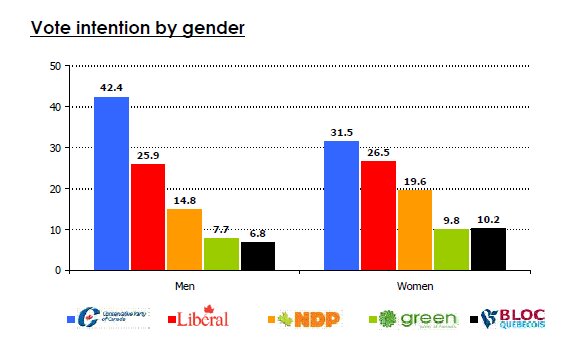
This isn't as drastic as the youth vs. senior because it cuts across all age groups, but there is still an important difference. And if you, like me, are both young and a woman, well, you've probably noticed that the composition of Parliament mostly reflects the votes of older men (who also make up most of the composition of Parliament). That's why it's important, not only to vote, but to be politically engaged. We do need more women in Parliament. We don't have nearly enough women running for election let alone winning. As Jack Layton points out, it's a historic first that even 40% of NDP candidates in this election are women.
All this has made me reflect on the history of women's votes. Well, no, actually that's a lie. I was already reflecting on the history of women's votes because I wrote a paper about it two weeks ago so it's all fresh in my mind. (I'm a nerd, so sue me.)
You may not know this, but up until the 1840s it was common practice for women in Montreal to vote. When we think about the history of women voting, we usually think of the suffragettes. But I kind of like these earlier women who weren't necessarily fighting for anything, who just went out and voted like it was no big deal.
The thing you have to understand is that before democracy became the big new thing in the late 1700s/early 1800s, position in the social hierarchy was a much better indicator of your power than gender. Anyone who's seen The Tudors or Marie Antoinette will know that women in court had a lot of power. And poor women were just as likely to riot in the streets as their male counterparts.
In order to be eligible to vote in most parts of the British Empire, you had to be a subject of the King/Queen, over the age of majority, and hold a certain amount of property in your name (this was to keep the voting to the more prosperous members of society, rather than the rabblerousers on the street). Traditionally, property was held by men, who passed it down to their oldest son. In the absence of sons, a daughter might inherit some property in the richest of families (think Anne de Bourgh in Pride and Prejudice), but not in families that were less well-off (think Mr. Collins and the Bennett sisters). Whoever did inherit would be expected to care for the widow (think Mrs. Dashwood from Sense and Sensibility). So women rarely held enough property to be eligible to vote, although they were not banned from doing so should they meet the requirements.
Quebec, however, maintained French Civil Law even under the British Empire. Under Quebec laws, property was jointly held by married couples, although the husband, as executor, was essentially considered to own the property. However, this meant that upon a man's death half of the marital property belonged to the widow, and the other half was generally split among all children who were of age. This meant that many widows of voters, especially those whose children were under the age of majority, were eligible to vote. It also meant that more daughters inherited property. And the "separation of goods"--a marital contract that stopped property from being held jointly by keeping it in the name of the person who brought it into the marriage--was common for upper middle class families like the Molsons (beer) and the Redpaths (sugar).
So in many parts of Quebec, and particularly Montreal, women were in the habit of voting. This was sometimes controversial, since polls were much more violent places in the early nineteenth century than they are now. And some people were afraid that married women who voted were being dragged to the polls by their husbands in order to provide an extra vote for the husband's chosen candidate. But all in all, women voters were accepted, especially the widows.
And then equality happened. The thing with equality is that it was all men who were born equal, not all people. It was liberté, égalité, fraternité. Women were kind of squeezed out of the political arena, firstly because most women who had power were aristocrats, and also because women were associated more and more with the private sphere: motherhood, domesticity, and being a good little wife. (Think the Victorian era, or maybe the 1950s.)
All of a sudden the idea of a poor little wife and mother being pushed onto the hustings and forced to say, "My name is x, I am a loyal subject of Queen Victoria, I have property worth x amount on x street, and I would like to vote for candidate x," in front of a jeering crowd of thugs, was unthinkable. (Yes, this was how people voted back in the day). Any woman who would do that willingly was clearly of questionable morality, and DUDE GUYS WE NEED TO SAVE THE WIMMENZ WHO ARE BEING FORCED TO PARTICIPATE IN DEMOCRACY!!!!! There was also a thing where they were afraid that if women could vote, women would try to run for seats, and then they would be pregnant all the time and never able to show up to Parliament, but that's just so ridiculous I'm not even going to try to unpack it.
In the Election Act passed in the Province of Canada (ie Ontario and Quebec) in 1849, buried in 30 pages of minutiae on determining county boundary lines and the legitimacy of returning officers, is this line:

Article 46: "And be it declared and enacted, That no woman is or shall be entitled to vote at any such election, whether for any County or Riding, City or Town."
Just one sentence! Just one sentence that in a stroke strips thousands of people of their voting privileges!
And it was such a non-issue that I haven't even been able to find a reference to it in any of the newspapers of the time.
So that's why I think it's important for women to vote. Because our government and our parliament were built in a time when people had that mindset. Most of the Fathers of Confederation were already in politics by the time that bill went through. Sir John A. Macdonald voted on it, probably without thinking about Article 46 because I'm pretty sure that's the shortest article in the entire Act. The only reason women got to vote again in the first place was a political ploy by Sir Robert Borden during the First World War, when he allowed the wives and mothers of soldiers to vote, knowing they would most likely vote for him and keep him in power.
Don't you think we should be reasserting our rights, reinserting our voices? I understand that a system created when the idea of women voting was counterintuitive, doesn't really speak to women. But that's exactly WHY we need to speak up for ourselves, why we need to get in there and MAKE things more accessible for women.
Because the old men that run our country right now? They sure ain't gonna do it.
I've already displayed the graphic that shows voting intentions by age. Here's another one, voting intentions by gender:
This isn't as drastic as the youth vs. senior because it cuts across all age groups, but there is still an important difference. And if you, like me, are both young and a woman, well, you've probably noticed that the composition of Parliament mostly reflects the votes of older men (who also make up most of the composition of Parliament). That's why it's important, not only to vote, but to be politically engaged. We do need more women in Parliament. We don't have nearly enough women running for election let alone winning. As Jack Layton points out, it's a historic first that even 40% of NDP candidates in this election are women.
All this has made me reflect on the history of women's votes. Well, no, actually that's a lie. I was already reflecting on the history of women's votes because I wrote a paper about it two weeks ago so it's all fresh in my mind. (I'm a nerd, so sue me.)
You may not know this, but up until the 1840s it was common practice for women in Montreal to vote. When we think about the history of women voting, we usually think of the suffragettes. But I kind of like these earlier women who weren't necessarily fighting for anything, who just went out and voted like it was no big deal.
The thing you have to understand is that before democracy became the big new thing in the late 1700s/early 1800s, position in the social hierarchy was a much better indicator of your power than gender. Anyone who's seen The Tudors or Marie Antoinette will know that women in court had a lot of power. And poor women were just as likely to riot in the streets as their male counterparts.
In order to be eligible to vote in most parts of the British Empire, you had to be a subject of the King/Queen, over the age of majority, and hold a certain amount of property in your name (this was to keep the voting to the more prosperous members of society, rather than the rabblerousers on the street). Traditionally, property was held by men, who passed it down to their oldest son. In the absence of sons, a daughter might inherit some property in the richest of families (think Anne de Bourgh in Pride and Prejudice), but not in families that were less well-off (think Mr. Collins and the Bennett sisters). Whoever did inherit would be expected to care for the widow (think Mrs. Dashwood from Sense and Sensibility). So women rarely held enough property to be eligible to vote, although they were not banned from doing so should they meet the requirements.
Quebec, however, maintained French Civil Law even under the British Empire. Under Quebec laws, property was jointly held by married couples, although the husband, as executor, was essentially considered to own the property. However, this meant that upon a man's death half of the marital property belonged to the widow, and the other half was generally split among all children who were of age. This meant that many widows of voters, especially those whose children were under the age of majority, were eligible to vote. It also meant that more daughters inherited property. And the "separation of goods"--a marital contract that stopped property from being held jointly by keeping it in the name of the person who brought it into the marriage--was common for upper middle class families like the Molsons (beer) and the Redpaths (sugar).
So in many parts of Quebec, and particularly Montreal, women were in the habit of voting. This was sometimes controversial, since polls were much more violent places in the early nineteenth century than they are now. And some people were afraid that married women who voted were being dragged to the polls by their husbands in order to provide an extra vote for the husband's chosen candidate. But all in all, women voters were accepted, especially the widows.
And then equality happened. The thing with equality is that it was all men who were born equal, not all people. It was liberté, égalité, fraternité. Women were kind of squeezed out of the political arena, firstly because most women who had power were aristocrats, and also because women were associated more and more with the private sphere: motherhood, domesticity, and being a good little wife. (Think the Victorian era, or maybe the 1950s.)
All of a sudden the idea of a poor little wife and mother being pushed onto the hustings and forced to say, "My name is x, I am a loyal subject of Queen Victoria, I have property worth x amount on x street, and I would like to vote for candidate x," in front of a jeering crowd of thugs, was unthinkable. (Yes, this was how people voted back in the day). Any woman who would do that willingly was clearly of questionable morality, and DUDE GUYS WE NEED TO SAVE THE WIMMENZ WHO ARE BEING FORCED TO PARTICIPATE IN DEMOCRACY!!!!! There was also a thing where they were afraid that if women could vote, women would try to run for seats, and then they would be pregnant all the time and never able to show up to Parliament, but that's just so ridiculous I'm not even going to try to unpack it.
In the Election Act passed in the Province of Canada (ie Ontario and Quebec) in 1849, buried in 30 pages of minutiae on determining county boundary lines and the legitimacy of returning officers, is this line:

Article 46: "And be it declared and enacted, That no woman is or shall be entitled to vote at any such election, whether for any County or Riding, City or Town."
Just one sentence! Just one sentence that in a stroke strips thousands of people of their voting privileges!
And it was such a non-issue that I haven't even been able to find a reference to it in any of the newspapers of the time.
So that's why I think it's important for women to vote. Because our government and our parliament were built in a time when people had that mindset. Most of the Fathers of Confederation were already in politics by the time that bill went through. Sir John A. Macdonald voted on it, probably without thinking about Article 46 because I'm pretty sure that's the shortest article in the entire Act. The only reason women got to vote again in the first place was a political ploy by Sir Robert Borden during the First World War, when he allowed the wives and mothers of soldiers to vote, knowing they would most likely vote for him and keep him in power.
Don't you think we should be reasserting our rights, reinserting our voices? I understand that a system created when the idea of women voting was counterintuitive, doesn't really speak to women. But that's exactly WHY we need to speak up for ourselves, why we need to get in there and MAKE things more accessible for women.
Because the old men that run our country right now? They sure ain't gonna do it.
Sunday, April 10, 2011
Some Resources
Check to see if a vote mob is happening at your school. And if they are, go. And if they aren't, plan one.
A really good summary of things you should know when you vote, including how to register, how to vote as a student away from home, etc.
A list of all registered federal parties.
A really good summary of things you should know when you vote, including how to register, how to vote as a student away from home, etc.
A list of all registered federal parties.
Saturday, April 9, 2011
Vote Mob Time! UVic and McMaster
Vote mob at the University of Victoria:
Coverage of the McMaster University vote mob on CBC's The National:
Also, this. I have no idea what it is, and I'm not sure whether or not to be amused.
Coverage of the McMaster University vote mob on CBC's The National:
Also, this. I have no idea what it is, and I'm not sure whether or not to be amused.
Looking Deeper
One of my favourite things about being a student is having all of these people, in a very small geographic area, learning about and becoming specialists in all sorts of different things. And then whenever you talk to people, they're all coming at the issue from very different perspectives and backgrounds.
"I'm actually not a fan of the Liberal platform," a friend of mine, majoring in Global Development Studies, mentioned recently. "It's so focused on numbers and money. A lot of social problems just can't be reduced to the economics of it."
I pointed out that the government's job is basically to allocate resources, so the money side of things is really all they can look at, beside making or changing laws. She shrugged.
"I just don't like this focus on the deficit. I feel like they're going to end up cutting programs that provide a lot of good services to communities. You know who's platform is really well thought out? The Green Party."
Fair enough.
Another friend, a business student, told me, "I was reading the Liberal platform, and I wasn't very impressed. They're so focused on getting rid of this deficit, they want to get rid of it too soon. Carrying a deficit isn't necessarily a bad thing. We're so used to hearing about the deficit in the 90's, which shouldn't have happened because our economy was in a good place. But when the economy is doing badly, being leveraged gives you a lot more flexibility."
She explained that worrying about keeping a balanced budget in tough economic times makes you afraid to spend, and the government should spend because it's easier for it to take a hit and go into deficit than it is for individuals to go into debt due to losing their jobs or not having the same social programs.
"The Conservatives are promising to get rid of it sooner," I said.
She rolled her eyes. "Their economic policy has always been for less tax, less spending, and whatever sounds good to the average person, who is not a trained economist. They're pandering to get the votes."
This post isn't intended to be for or against any particular party. I just want to encourage you to approach the party platforms critically, and talk about them with people who are coming from a completely different perspective. Discussion is healthy!
"I'm actually not a fan of the Liberal platform," a friend of mine, majoring in Global Development Studies, mentioned recently. "It's so focused on numbers and money. A lot of social problems just can't be reduced to the economics of it."
I pointed out that the government's job is basically to allocate resources, so the money side of things is really all they can look at, beside making or changing laws. She shrugged.
"I just don't like this focus on the deficit. I feel like they're going to end up cutting programs that provide a lot of good services to communities. You know who's platform is really well thought out? The Green Party."
Fair enough.
Another friend, a business student, told me, "I was reading the Liberal platform, and I wasn't very impressed. They're so focused on getting rid of this deficit, they want to get rid of it too soon. Carrying a deficit isn't necessarily a bad thing. We're so used to hearing about the deficit in the 90's, which shouldn't have happened because our economy was in a good place. But when the economy is doing badly, being leveraged gives you a lot more flexibility."
She explained that worrying about keeping a balanced budget in tough economic times makes you afraid to spend, and the government should spend because it's easier for it to take a hit and go into deficit than it is for individuals to go into debt due to losing their jobs or not having the same social programs.
"The Conservatives are promising to get rid of it sooner," I said.
She rolled her eyes. "Their economic policy has always been for less tax, less spending, and whatever sounds good to the average person, who is not a trained economist. They're pandering to get the votes."
This post isn't intended to be for or against any particular party. I just want to encourage you to approach the party platforms critically, and talk about them with people who are coming from a completely different perspective. Discussion is healthy!
Student News
Students at McMaster participated in a flash mob that was allowed into a Conservative rally. True story. "The fact that they let us in today represents that they are listening, they're aware of the student vote," said one of the organizers. Yay student power!
Some people are upset advance polling coincides with Easter weekend. "It's the sheer stupidity of it," says one lady. Personally I think it's genius. Lots of students are going to be heading back to their hometowns for the weekend, whether or not they celebrate Easter, so it's the ideal time to vote in your home riding if you choose to do so!
Some people are upset advance polling coincides with Easter weekend. "It's the sheer stupidity of it," says one lady. Personally I think it's genius. Lots of students are going to be heading back to their hometowns for the weekend, whether or not they celebrate Easter, so it's the ideal time to vote in your home riding if you choose to do so!
Subscribe to:
Posts (Atom)