Showing posts with label women's issue. Show all posts

Monday, May 2, 2011

Electoral Politics: Going Places

Citizen Engagement: Going Up (say this in an elevator voice)

Thanks to social media campaigns and the uprisings in the Middle East, Canadian voters are super engaged this election. But we already knew that, didn’t we?

Everyone is particularly impressed that young people seem to be so engaged.

Montreal-based Apathy Is Boring, one of several non-partisan organizations that have sprung up to promote increased voting in this federal election, hailed the busy advance polls as a harbinger of hope for Canadians’ interest in the political process.

“WE. ARE. DOING IT,” the group boasted after the Easter weekend numbers came in.
“Let’s keep turning up in record numbers to prove that young Canadians care about democracy, and that apathy is boring.”

Coalitions: Going Down

While Stephen Harper is ratcheting up his coalitions-are-scary-things rhetoric, and more and more Canadians seem to believe him, coalitions are both normal and stable in other parts of the world.

“We’ve have been forming coalition governments at the national and state level for a long time,” says Norman Abjorensen, a leading political commentator and professor at the Australia National University in Canberra. “And the sun has always risen the following day.”

The typical pattern in Australian federal politics, says Abjorensen, is either a leftish Labour government or a coalition of right-of-centre Liberals and rural Nationals.

“We change governments rarely here,” he says. “Only six changes in more than 60 years. No coalition has fallen except at the ballot box or on the floor of the house when in a minority in 1941.”

Western democracies such as Canada and the United Kingdom are behind the times, argues London School of Economics political scientist Jonathan Hopkin.

Not that Canadians haven’t thought about it:

A few days after Trudeau’s comeback victory in the 1980 federal election, he invited NDP leader Ed Broadbent to his office.

“I had a surprise for him,” Trudeau, who had just led his Liberals to a majority government, recalled in his 1993 book Memoirs.

“In an attempt to negotiate some sort of alliance with his party, I offered him and his colleagues some senior positions in our cabinet,” wrote Trudeau, explaining that his scanty take in Western Canada — just two seats, both in Manitoba, out of 143 Liberal MPs — had left him craving some of the widespread western representation of the NDP.

National unity, Trudeau believed, “would be strengthened if we could consolidate our forces.” He noted that there had been similar Liberal-NDP collaboration talks “on and off since (Lester B.) Pearson’s day,” but that Broadbent, who feared that his party would lose its power and credibility, quickly declined the offer.

Women in Politics: Going Nowhere

I mean that two ways: women who are in politics aren’t leaving anytime soon, but women are making very few gains in politics right now.

Anita Neville, a Liberal Member of Parliament and former minister for the status of women, agrees that more needs to be done to recruit women, and that the tone of Canadian politics is a barrier to that goal.

“I don’t think any of the parties have done a great job recruiting candidates,” she said at a campaign rally in Winnipeg, Manitoba last week.

“The rancor and nastiness of the political discourse turns off” many women, Neville said, adding that the atmosphere before the last election was “a really ugly Parliament.”

The New Democratic Party said April 11 it had set an “historic first” by having women as 40 percent of its nominated candidates. Still, Equal Voice said on its website that only 31 percent of NDP candidates in what it gauges are winnable ridings are women. That figure compares with 27 percent for the Liberals and 22 percent for the Conservatives. The Conservative Party did not respond to requests for comment yesterday about this issue.

Sunday, May 1, 2011

You may not have realized this, but I am actually not an ice cream cone

So there was this thing called "election-themed flavour of the week, and was like, "Oh, I wonder what that is? Perhaps a selection of the most popular stories of the week!" My Awesome Housemate was like, "The flavour of the week should be orange crush!" And then we clicked on it and it is neither of those things. Instead it's a collection of pictures of attractive female candidates. Can I be appalled? The "sexiest election candidate" was one thing, because it was equal-opportunity and also you knew what you were getting into when you clicked on the link. And this one also has little blurbs underneath the pictures that half the time sounds like a personals ad… you know, "enjoys mountain biking with that special someone!" SO disgusted right now. Women are not ice cream cones. "Flavour" of the week, pah.

Saturday, April 30, 2011

Saturday Morning Catch-Up

Some news stories from the past few days I haven't gotten around to yet.

1) What would a Harper majority look like? To me, scary, but I think that this author is intentionally trying to be terrifying:

While parties in modern Canada rarely ask for a majority expressly to do big things, it endows them with unfettered authority. A majority as prime minister allows you to summon and dismiss Parliament, set election dates and name the governor general, senators and judges, among other appointments.

By and large, you are — borrowing a line from Globe and Mail columnist Jeffrey Simpson — a "friendly dictator."

So what would Stephen Harper do? While he may pay lip-service to social conservatives, he is unlikely to reopen the debate on abortion, same-sex marriage and capital punishment. He knows that's playing with fire.

What he is more likely to do, though, is what he is doing already: appoint more conservative judges, deny funding to liberal-minded non-governmental organizations like Planned Parenthood, abolish the gun registry and get tough on crime.

Where he is likely to move aggressively is reshaping the state? Here, expect him to use the deficit as reason to shrink the size of government. That may mean slashing the public service, starving (or selling) the CBC, and privatizing government services.

Expect him to lower taxes and explore ways to empower the individual. Expect him to reform the Senate. Expect him to offer the provinces new authority, including Ottawa's residual powers. While he is unlikely to initiate constitutional reform (he doesn't like convening first ministers), expect the national government to be less national.

At the same time, watch for the Conservatives to give more substance to citizenship, which they think is too easy to acquire. There will be new emphasis on national history and national symbols, particularly the monarchy. The Conservative will continue to trumpet the North, espousing a new kind of nationalism.

Abroad, Canada will continue to regard the United Nations suspiciously. There will be no return to peacekeeping, as the Liberals suggest, or a human-security agenda. Military spending will rise while international assistance is reassessed. A foundering CIDA will be reorganized, even abolished.

The government will pursue a new deal with the United States on border and security issues. It will build on new free trade with Europe. Canada will remain Israel's best friend.

Those who expect the same tone and tenor of the last five years — a centrist stewardship, reflecting a comfortable moderation, veering right only on the margins — should not be surprised to see the empowered Conservatives abandon that kind of caution.

*shudder* Also, I just want to say that I don't think you need to make citizenship harder to get when the majority of adults born in Canada already can't pass citizenship tests. I remember my friends memorizing long lists of lieutenant-governors past, and I can't even name any of the current ones.

2) Reality Check on post-election scenarios and the constitution. This lays out potentials for what might/could happen with various election results. With a Conservative minority:

All we know for certain is that in this third scenario, a minority Conservative government would have to table a throne speech to lay out its priorities and a budget (the one in March was never passed), presumably within the next month or so.

If a minority Conservative government were to lose either of those votes, or any confidence vote within, say, four to six months, Harper would have to resign. But he would have the option of asking Gov. Gen. David Johnston for another election.

Normally, the governor general is supposed to act on the "advice" of the prime minister. But in special circumstances like these, "the reserve powers of the Crown come into play," Franks points out.

"These reserve powers permit the governor general to reject Mr. Harper's advice if he requests a dissolution when he holds a minority of seats in the House of Commons and is defeated early in the session of the new Parliament."

At that point, the governor general would inquire whether another party leader could gain the confidence of the House and govern instead, with the support of one or more other parties.

Franks suggests Johnston might well make the leaders commit to such an arrangement for 18 months to two years; indeed, commit to it in writing and make the agreement public.

Franks is basing these time limits - at least four to six months before Johnston would grant another election, and 18 to 24 months for an alternative government to work - on what Adrienne Clarkson wrote about her preparations in case Paul Martin's minority Liberal government fell back in 2004.

That was the year, incidentally, when Harper, Bloc Leader Gilles Duceppe and NDP Leader Jack Layton prepared a letter to remind Clarkson that she didn't necessarily need to grant an election if Martin lost a confidence vote in the House.

Overall, Franks says, "the governor general's first and most important duty is to ensure that there is a prime minister."

3) There have been some youth debates this week, which are interesting to look at not only because it's young people being completely politically involved, but also because they actually cover youth issues (and articulate what they think youth issues actually are). For example:

Elizabeth Dubois, chair of the campus political action committee for the Young Liberals of Canada, reminded young Canadians of the Liberals' Learning Passport, which would provide $1,000 of financial assistance to post-secondary students each year for up to four years.

She said the platform promise was designed to ensure youth had access to "tools to build our future."

Alykhan Velshi, who is working a second election in the Conservative party war room, insisted that the Liberal plan isn't the best option for youth.

"It's very deep in their platform . but they're also taking something away. They're going to raise taxes on students," he warned, referring to the Liberals' plan to eliminate current textbook tax credits currently offered to students.

The pair was joined by Isaac Cockburn, who has worked at NDP headquarters in Ottawa and as an assistant to the NDP's Nathan Cullen, and Jonathan Halasz, co-president of the Carleton University Green party. Each party representative is under the age of 30.

The Bloc Québécois declined to join the English-language debate.

Cockburn immediately echoed his party leader Jack Layton's message that "Ottawa is broken."

"This type of back and forth is what he's talking about," he said, promising he wouldn't join "rigorous partisan stuff" as his peers poked at their opponents' policies.

Cockburn said Layton was the sole leader who would address rising tuition fees, while other parties have said the concern is not a federal responsibility.

4) It's hard to respect our MPs when their behaviour would be getting them a time-out if they were children.

How can the grown men and women who wish to govern our nation expect to be taken seriously as trustworthy, thoughtful people when their behaviour suggests they are hysterical toddlers? Whenever I tune into Question Period I last about 20 seconds before I have to change the channel because the bickering sounds like an out-of-control Middle School classroom.

So how about it, folks? If you want to govern the country, how about showing some self-control and good sense? Quit shouting in the background while other people are trying to speak. Quit calling each other names. Quit using scare tactics to try to convince the populace that negotiating in a coalition scenario is worse than having one man’s ideas shoved down our throats.

5) If young women voted, things would be different. We already know that the composition of Parliament is more likely to reflect the votes of older men rather than younger women. This survey also points out to some striking differences of opinion between young women and young men.

“Time after time I have seen in national polls that young women tend toward views that favour environmental sustainability and social justice, while young men’s attitudes tend toward maintaining the status quo,” says the President of McAllister Opinion Research.

Here's some stats:

Agree/Strongly agree that “Canadian girls receive adequate support to achieve their potential in life.”

63% of young women
100% of young men

Agree/Strongly agree that “Violence against women is a serious problem in Canada today.”

92% of young women
42% of young men

When asked if the following facts should be a concern or not for Canadians, here is what young women and men had to say:

“Teenage girls are 3 times as likely as boys to suffer from depression”

96% of young women are concerned
61% of young men

“Men outnumber women 4 to 1 among Canada’s elected representatives”

80% of young women are concerned
38% of young men

“2/3 of minimum wage workers in Canada are women”

90% of young women are concerned
55% of young men

I think the first statistic is possibly the most striking. All the young men surveyed felt Canadian girls receive adequate support to achieve their potential, but less than two thirds of the young women surveyed agreed.

Wednesday, April 27, 2011

Canada's First Woman MP is My Idol

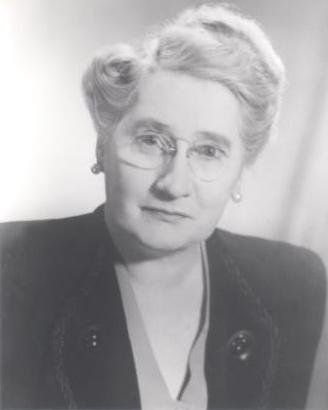
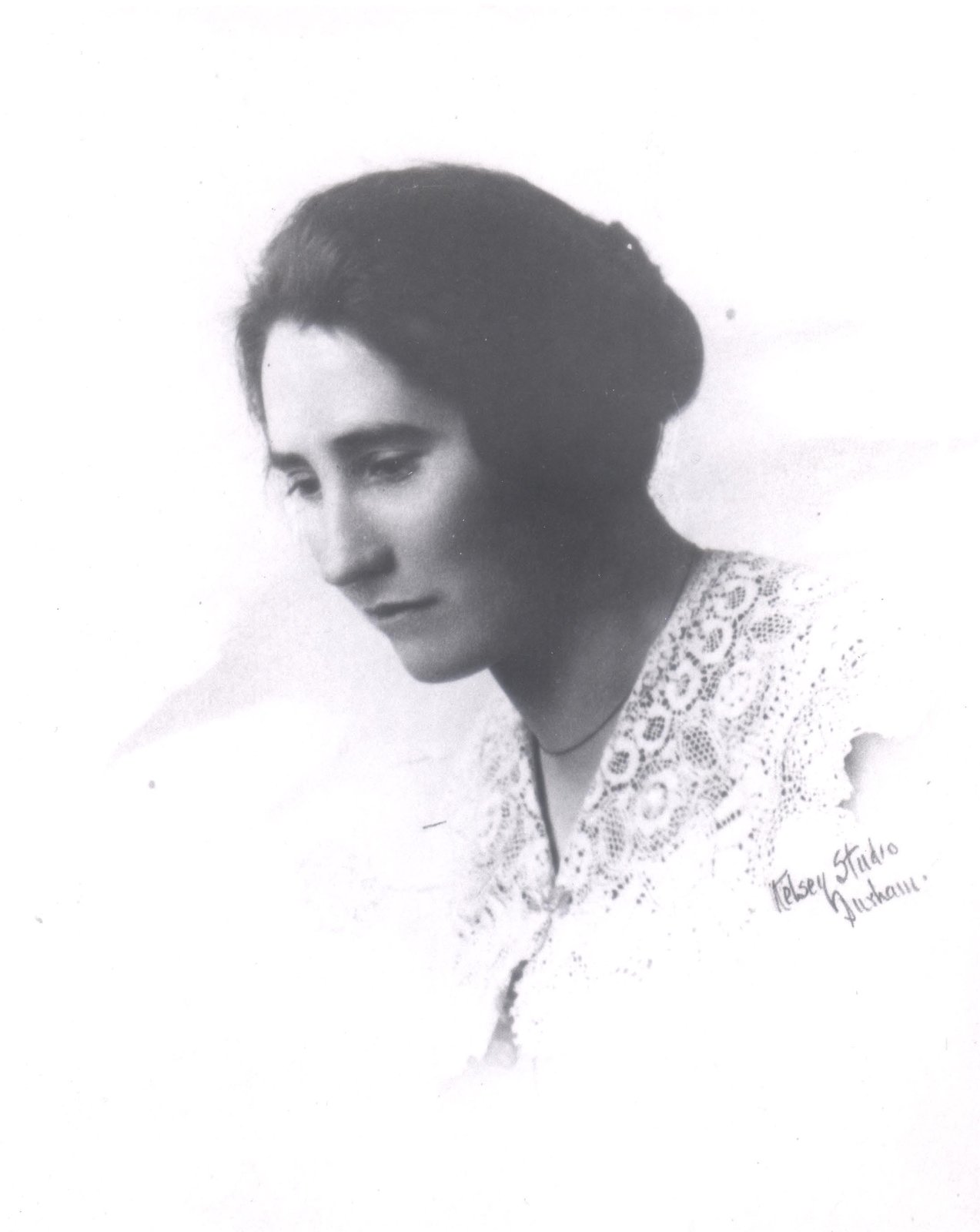
We now pause our regularly scheduled election coverage for a brief homage to this woman:


So I am a big fan of all the #deadPMs on Twitter. Recently they’ve been joined by some dead premiers, Fathers of Confederation, etc. and it struck me that the whole thing was becoming quite a sausagefest. Where, I asked myself, is Agnes Macphail, the most bad-ass dead woman MP in Canadian history? (It turns out there is an Agnes Macphail twitter but it’s been inactive for over a year.) So I Wikipedia’ed her, found the links to the Agnes Macphail Digital Collection, and discovered this 1928 speech (pages 1, 2, 3, and 4.

Basically Agnes Macphail is many shades of awesome. I think this quote aptly applies to most Conservative press conferences these days: “However, after reading the speech very carefully I think myself it is an exceedingly clever speech—how adroitly it says nothing at all!”

She also catches the economic signals foreshadowing the Great Depression:
I had the privilege, and I consider it a very great privilege, of visiting last summer very many rural homes in Ontario, Manitoba and Saskatchewan, and I certainly did not find in those homes the prosperity that I read about in the speech from the throne. I found people struggling to meet debt, and worrying over taxes and meeting the payment of their mortgages. I thought the conditions were particularly bad in the province of Manitoba. I believe it was said by some member this afternoon that they no longer grew grain in Manitoba. Well, I think that was true this year.
[…]
I do not consider that we can boast of our prosperity until that prosperity has reached the homes of the mass of the people. I think it is quite likely that the prosperity that has undoubtedly arrived in certain classes and sections of Canada will continue and will likely increase, until possibly it reaches boom dimensions, and will be followed by a crash or a long depression comparable to the one out of which we are just emerging [the depressed conditions following the First World War and into the 1920s].
[…]
One of the things to which I refer is the present Bank act. I notice in the Weekly News of February 3rd, printed in Winnipeg, that the Bank of Nova Scotia made a dividend this year of 16 ½ per cent, which seems a snug little dividend. The Canadian Bank of Commerce made a dividend of 12 per cent, with a bonus of one dollar. It was the same with other banks; evidently they are all making very great profits. Now there is a general feeling in farming districts that our banking system is not all it should be, and that some line of setting up a bank of issue and rediscount should at once be instituted.

Macphail was a pacifist, as you can see in her comments on the munitions industry. She first argues that international trade of arms and munitions should be banned (that would, actually, have saved us from so many problems…) and she’s against the private manufacture of arms:

I see no reason why the manufacture of munitions which are designed to bring about the death of human beings should be in the hands of private individuals who can and who have used this power for private gain. Let us now make a law stating that, if the worst came to the worst at any time in the future and we must face war, all property will be administered by the state; that is, there would be a complete conscription of wealth. I feel this would have a moderating influence upon certain elements in Canada.

Canadian industry had made HUGE money off the First World War (as had America industry) and Macphail may have been correct in fearing that munitions makers were ready to warmonger for their own personal gain. Or maybe she was just pissed at Sam Hughes for giving the munitions contracts to his buddies.

Macphail would have been pro-prison farms if she were alive today. (I also feel like the first prison farms were established around this time with her support, but have found no evidence to prove this.) Her arguments here are very similar to the ones used by protesters of the prison farm closures, except more patronizing:

In our whole system of taking care of prisoners we should look to the good that we can do to the prisoner while he is detained by the state, making him feel that the state is fair to him. That is why I want him to be paid a decent wage for his work, from which wage, of course, his keep must be deducted. We must never forget, too, that the family of the prisoner possibly suffers more than the prisoner himself, and when the prisoner comes out, there should be, shall we say, a fatherly hand of the government to guide that man into civil life, to re-establish him. So many of them when they first get out try for a few days or weeks to go in what we call a straight way, and not being able to do that they very soon revert to crime.

Here’s what she has to say on party politics and majority governments. I have to say I agree with her, more or less, on both fronts:

I am not interested in party politics; I am not interested in parties, although I must say in all fairness that I am very much interested in the people who compose the parties. I am at all times ready, and indeed anxious, to support legislation which to my mind is beneficial to the constituency I have th honour to represent—I believe that is the correct form—and to the country as a whole.
[…]
I do not believe that when you have a stable government—one with a very comfortable majority, you get a good government. I may be wrong; I sometimes am, but I think not in this case, and so, having in power a stable government, one with a very comfortable majority, a majority that unfortunately has been added to by men who should have known better [here she is referring to MPs not voters], I do not see how we can expect a legislative program that will be pleasing to our constituencies. But at least we are here to get for the common people of Canada the best that we can, and I am here sitting ready to be pleasantly surprised by the government.

What a superstar.

We now return to our regularly scheduled programming.

Sunday, April 24, 2011

Vote Mob Extravaganza Continues: UBCO & Kelowna, Brandon, Brock, Regina

UBC Okanagan & Kelowna vote mob got all their candidates out, which is awesome to see. Also: how are three of the four candidates women?? I have never seen this before but it makes me happy!


I LOVE the song choice for Brandon U's vote mob! (Although, apparently, Stephen Harper plays it on his tour bus. Finally, something Harper and I can agree on: classic rock.)


Brock's vote mob is particularly patriotic, although I was terrified someone was going to step on the flag!


I like Regina's mascot. Is that... a gopher??? (Update: Ok so it's apparently a cougar who interrupts pirate duels and marriage proposals in order to get people to vote. WIN for most awesome mascot ever!!!)


With all the vote mobs today, it's really got me thinking that one of the really nice parts of this is being able to see universities across the country. Like Brandon University for example--I've heard of it, maybe, but I don't know anyone who goes there and I never gave it too much thought, and now I get to see all the awesome and creative and politically engaged students. And all the vote mobs running across campus, through libraries and food courts and student unions, that's really really neat to see. It's too bad it's such an icky time of year--I know my campus shows up best in fall when the leaves change. Maybe we can do this all again next time!

Monday, April 11, 2011

Women, the Vote, and Raising One's Voice

Equal Voice, which is a non-profit organization dedicated to getting more women elected to all levels of government, has a new initiative called the iCommit Campaign, basically asking young women to commit to voting in the election, and staying engaged in politics beyond. If you're a woman between the ages of 18 and 24, you should go do just that.

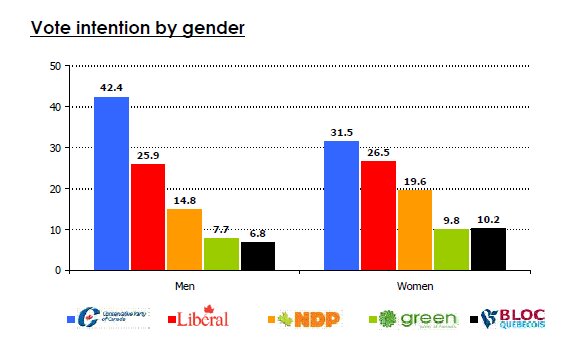
I've already displayed the graphic that shows voting intentions by age. Here's another one, voting intentions by gender:


This isn't as drastic as the youth vs. senior because it cuts across all age groups, but there is still an important difference. And if you, like me, are both young and a woman, well, you've probably noticed that the composition of Parliament mostly reflects the votes of older men (who also make up most of the composition of Parliament). That's why it's important, not only to vote, but to be politically engaged. We do need more women in Parliament. We don't have nearly enough women running for election let alone winning. As Jack Layton points out, it's a historic first that even 40% of NDP candidates in this election are women.

All this has made me reflect on the history of women's votes. Well, no, actually that's a lie. I was already reflecting on the history of women's votes because I wrote a paper about it two weeks ago so it's all fresh in my mind. (I'm a nerd, so sue me.)

You may not know this, but up until the 1840s it was common practice for women in Montreal to vote. When we think about the history of women voting, we usually think of the suffragettes. But I kind of like these earlier women who weren't necessarily fighting for anything, who just went out and voted like it was no big deal.

The thing you have to understand is that before democracy became the big new thing in the late 1700s/early 1800s, position in the social hierarchy was a much better indicator of your power than gender. Anyone who's seen The Tudors or Marie Antoinette will know that women in court had a lot of power. And poor women were just as likely to riot in the streets as their male counterparts.

In order to be eligible to vote in most parts of the British Empire, you had to be a subject of the King/Queen, over the age of majority, and hold a certain amount of property in your name (this was to keep the voting to the more prosperous members of society, rather than the rabblerousers on the street). Traditionally, property was held by men, who passed it down to their oldest son. In the absence of sons, a daughter might inherit some property in the richest of families (think Anne de Bourgh in Pride and Prejudice), but not in families that were less well-off (think Mr. Collins and the Bennett sisters). Whoever did inherit would be expected to care for the widow (think Mrs. Dashwood from Sense and Sensibility). So women rarely held enough property to be eligible to vote, although they were not banned from doing so should they meet the requirements.

Quebec, however, maintained French Civil Law even under the British Empire. Under Quebec laws, property was jointly held by married couples, although the husband, as executor, was essentially considered to own the property. However, this meant that upon a man's death half of the marital property belonged to the widow, and the other half was generally split among all children who were of age. This meant that many widows of voters, especially those whose children were under the age of majority, were eligible to vote. It also meant that more daughters inherited property. And the "separation of goods"--a marital contract that stopped property from being held jointly by keeping it in the name of the person who brought it into the marriage--was common for upper middle class families like the Molsons (beer) and the Redpaths (sugar).

So in many parts of Quebec, and particularly Montreal, women were in the habit of voting. This was sometimes controversial, since polls were much more violent places in the early nineteenth century than they are now. And some people were afraid that married women who voted were being dragged to the polls by their husbands in order to provide an extra vote for the husband's chosen candidate. But all in all, women voters were accepted, especially the widows.

And then equality happened. The thing with equality is that it was all men who were born equal, not all people. It was liberté, égalité, fraternité. Women were kind of squeezed out of the political arena, firstly because most women who had power were aristocrats, and also because women were associated more and more with the private sphere: motherhood, domesticity, and being a good little wife. (Think the Victorian era, or maybe the 1950s.)

All of a sudden the idea of a poor little wife and mother being pushed onto the hustings and forced to say, "My name is x, I am a loyal subject of Queen Victoria, I have property worth x amount on x street, and I would like to vote for candidate x," in front of a jeering crowd of thugs, was unthinkable. (Yes, this was how people voted back in the day). Any woman who would do that willingly was clearly of questionable morality, and DUDE GUYS WE NEED TO SAVE THE WIMMENZ WHO ARE BEING FORCED TO PARTICIPATE IN DEMOCRACY!!!!! There was also a thing where they were afraid that if women could vote, women would try to run for seats, and then they would be pregnant all the time and never able to show up to Parliament, but that's just so ridiculous I'm not even going to try to unpack it.

In the Election Act passed in the Province of Canada (ie Ontario and Quebec) in 1849, buried in 30 pages of minutiae on determining county boundary lines and the legitimacy of returning officers, is this line:


Article 46: "And be it declared and enacted, That no woman is or shall be entitled to vote at any such election, whether for any County or Riding, City or Town."

Just one sentence! Just one sentence that in a stroke strips thousands of people of their voting privileges!

And it was such a non-issue that I haven't even been able to find a reference to it in any of the newspapers of the time.

So that's why I think it's important for women to vote. Because our government and our parliament were built in a time when people had that mindset. Most of the Fathers of Confederation were already in politics by the time that bill went through. Sir John A. Macdonald voted on it, probably without thinking about Article 46 because I'm pretty sure that's the shortest article in the entire Act. The only reason women got to vote again in the first place was a political ploy by Sir Robert Borden during the First World War, when he allowed the wives and mothers of soldiers to vote, knowing they would most likely vote for him and keep him in power.

Don't you think we should be reasserting our rights, reinserting our voices? I understand that a system created when the idea of women voting was counterintuitive, doesn't really speak to women. But that's exactly WHY we need to speak up for ourselves, why we need to get in there and MAKE things more accessible for women.

Because the old men that run our country right now? They sure ain't gonna do it.